I went on a bit of a binge reading about travel writers and Hawaii. After going to Japan with my 1-year-old and 4-year-old, we stopped in Honolulu and Kauai for nine nights.
I’ve been to Hawaii many times before and had a vague understanding of its history. But as a kid, you don’t think about how a place used to be. You don’t consider what’s been lost or how America forced it to change. Or how beautiful the indigenous culture itself is.

Here’s the timelines of the Hawaiian travelogues I read, in the order I read them in. Going back, I’d start first with the last one.
- 1866, Letters from Hawaii by Mark Twain (here is a book about his general experience there)
- 1873, Six Months in Hawaii by Isabella Bird (yes, the same one who later went to Japan)
- 1889/1893, Travels in Hawaii by Robert Louis Stevenson
- 1958, The Victorian Visitors by Alfons L. Korn (1860’s letters)
Many others came on my radar from doing these readings which I didn’t get a chance to read. This is a variegated list of authors who traveled there and wrote about it which I did not manage to get to, as well as some old travelogues from random 19th century people:
- 1827, Narrative of a tour through Hawaii, or Owhyhee by William Ellis
- 1841-42, Narrative of a journey round the world by Sir George Simpson
- 1843, Scenes and Scenery in the Sandwich Islands, by James Jackson Jarves
- 1847, A Residence of Twenty-one Years in the Sandwich Islands by Rev. Hiram Bingham
- 1849, A Sketcher’s Tour Round the World by Robert Elwes
- 1882, Life and times of Mrs. Lucy G. Thurston
- 1883, Fire Fountains: The Kingdom of Hawaii, Its Volcanoes, and the History of Its Missions by Constance Gordon Cumming
- 1892, A Trip to Hawaii by Charles Warren Stoddard
- Herman Melville
- Jack London
- James Michener
Mark Twain in Hawaii
It turns out that Hawaii launched Mark Twain’s career. I had previously enjoyed his two European travelogues and also read a book on his travels to Bermuda, so Hawaii was one I approached with optimism.
I have to say that after reading this I feel like I have such a strong background in the Sandwich Islands of the 1860s. It introduced me to the sugar and whaling industries, touches on its missionary initiatives (of which there were many), discusses the royal family and its traditions, and also importantly introduces a good deal of Hawaiian customs and folklore.
But for all that I found it slow-going. Twain was writing for an audience of the Sacramento News which means he had a specific way he had to write and people to appeal to. His use of a fake character, Mr Brown, I also found off-putting although I know this is a device he uses in his other travelogues too. But this was interesting at times and did feel worth reading as I was sitting on a bus, or in the cafe at Bishop Museum, for example, in Honolulu in October 2025.
Isabella L. Bird
I first learned of Isabella Bird when I read her Japan travelogue which was from five years later. This one, in 1873, shows that while she seems to have been well-traveled prior, her true adventurous spirit didn’t come out until Hawaii.
She arrives en route from New Zealand and makes an unexpected stop of 8 months in order to help a fellow traveler with her sick son. She was really meant to go to San Francisco and then the Rocky Mountains. But quickly during her Honolulu stay she decides to head to the Big Island where she gets used to some very hard going riding during her sightseeing. I’d be curious to know if she did this kind of thing on her other travels beforehand. She learns to ride like a man here and by the end is confident going everywhere on her own, without even a guide!
Robert Louis Stevenson
Robert Louis Stevenson, the famed author of Treasure Island, stayed in Hawaii in 1889 and then again in 1893. This book is a compilation of his writings from Honolulu, Kona (on the Big Island) and Molokai (the lepers’ colony). It was fitting to still be reading this as my Hawaii trip ended and I transitioned to the California part of our holiday, in Pebble Beach, where he also spent some time (there’s a Robert Louis Stevenson house in Monterey).

One of my main takeaways from his stay there is that he was fascinated by Hawaiian culture — to the point that he was about to write an epic which even his wife was trying to deter him from. She (perhaps rightly) believed that she knew his strengths in writing lay in characterisation, not in writing some saga of history about a people he had only known for a few months. His letters show the type of place he was living in (not particularly luxurious) and also give us a peak into the intensity of his travels around the South Pacific. Famously, he was in Samoa when he died.
Lady Jane Franklin
I went down a bit of a rabbit hole when I found out about the fascinating Lady Jane Franklin. This woman was mentioned in Isabella Bird’s writings on Hawaii with the intriguing statement that she had been given some land by Queen Emma in Kauai.
I did a lot of reading on Lady Franklin and her various adventures. She was the wife of an Arctic explorer, Sir John Franklin, who disappeared on an expedition in the 1840’s. She subsequently organised (and practically forced) the UK, US and Russian governments to send out search parties for him. There is a lot written about this ill-fated expedition which sought the Northwest Passage.
Lady Franklin didn’t end up in Hawaii until 1861, but I still wanted to read something about her. This led me down journey of readings…

At first, I couldn’t find much in the way of books. Somewhat of a biography was compiled in 1923, edited by a later relation – although a subsequent biographer would attribute ‘mental blindness’ to him in his over-romantised depiction of Lady Jane Franklin. It does include lots of interesting snippets from her actual journals. I also read this more recent biography, Lady Franklin’s Revenge by Ken McGoogan from 2010.
Her niece, Sophia Cracroft, wrote quite a bit, having accompanied Lady Franklin on her extensive travels. And I mean extensive! They went all over the world; even before her husband disappeared, Jane travelled a lot and it was a way of life for her. She in fact didn’t marry until she was in her late 30’s, but ended up dedicating her later years to memorialising him after his disappearance — and traveling. A lot of traveling.
I finally got into the meaty bit of her Hawaii travels via the book The Victorian Visitors, which deals specifically with her and her niece’s trip to Hawaii. I would have read this to begin with, but it is an obscure compilation published in the 1950’s — buried under her many another adventures! This was finally a Hawaii travelogue that made sense when considering my recent trip was mainly to Kauai, where we spent seven nights (after two nights in Waikiki on Oahu).
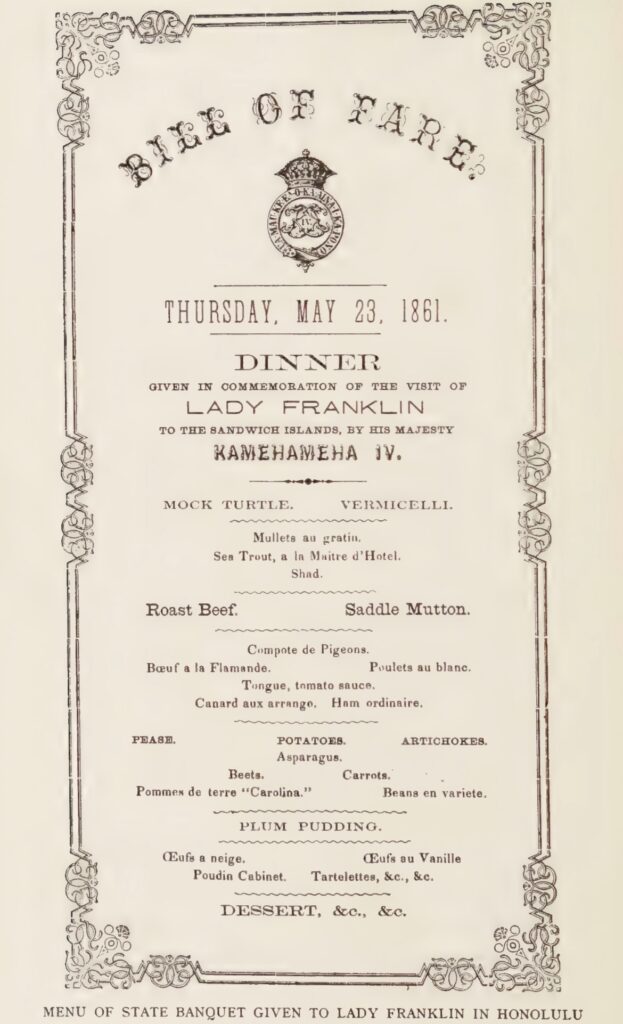
It’s wonderful how I only found out about Lady Franklin from an offhand reference to her in Isabella Bird’s own trip to Kauai, which was only a few pages in itself. The letters are written by her niece, who writes from the perspective I love most: lots of astute observations and depictions of what life was like for a genteel traveler in the 1860s. They had so many interesting interactions with historical figures — the kind you can look up on Wikipedia and see what happened to. Like all the key Hawaiian royals of the era, for example. I loved this travelogue! Letter compilations are my sweet spot, I think.
One more thing that was so cool when reading this — it is from 1861. The Mark Twain one was from 1866, and Isabella Bird visited in 1873. Robert Louis Stevenson was there in 1889. I also learned a lot about Hawaiian history when I visited the Bishop Museum in Honolulu, as well as through all my googling when intriguing names came up during my reading. So reason The Victorian Visitors, I really felt like I’d gained a broad, holistic understanding of this whole era and was seeing all these people whom I later knew would become a monarch, or have various impacts on Hawaii.
For example, the Robert Wyllie who hosts them is Scottish by birth, and he became the king’s main confidante in Hawaii and was responsible for much of its governance while he lived there. He was also the founder of Princeville, in which Franklin gained a piece of while she was there. This was also where we stayed on our recent trip at the 1Hotel Hanalei Bay! I thought it was just a modern-day posh enclave but it turns out it was named after the little prince they met in 1861 and used to include Wyllie’s coffee plantations.
I couldn’t stop reading about her, as I went back and read the often-quoted biography Portrait of Jane by Frances Woodward. I was hoping to get more content on her excursions in Egypt in the early 1830s, but alas, there was not much more in there. Her letters and diaries are extensive though and I imagine if I could ever get my hands on them, there would be a lot to glean (a quest for another day). As for its depictions of her Hawaii trip, it didn’t give me much more more insight on what she did there compared with Victorian Visitors, which was in itself a wonderful trove of mid-19th century Hawaii lore.
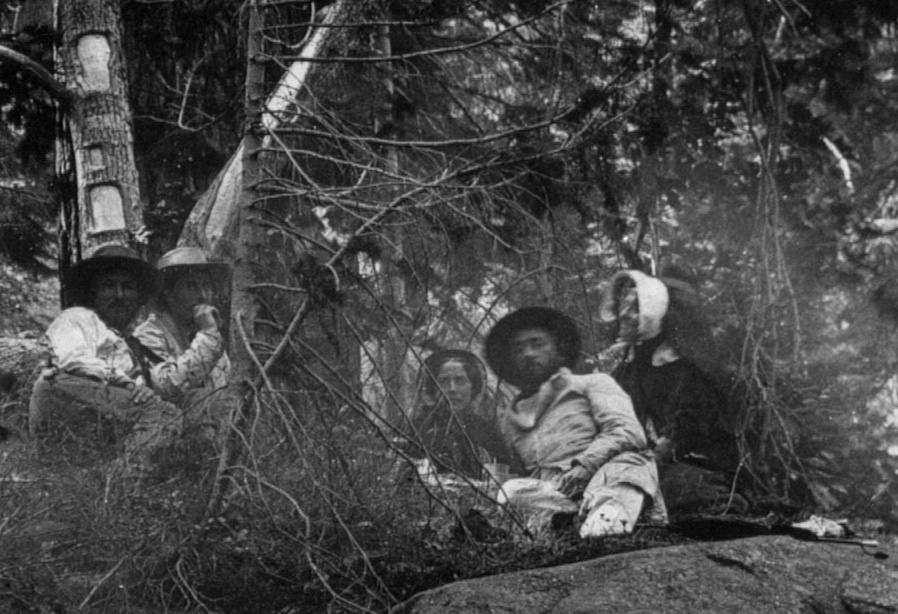
So, I ended up plodding through all the biographies above, as well as a pop culture favourite horror book called The Terror by Dan Simmons (no Hawaii mentioned here, but lots of references to the Franklins). This is something I quite enjoy about my travelogue obsession… I often come across random characters who turn out to have fascinating histories and it leads me to entirely different types of travels to learn about.
Want to find out more about me and where I’m heading to next? Take a look here. And please note I may receive commissions on books purchased from Bookshop.org. Click here for a look at my bookshelf.