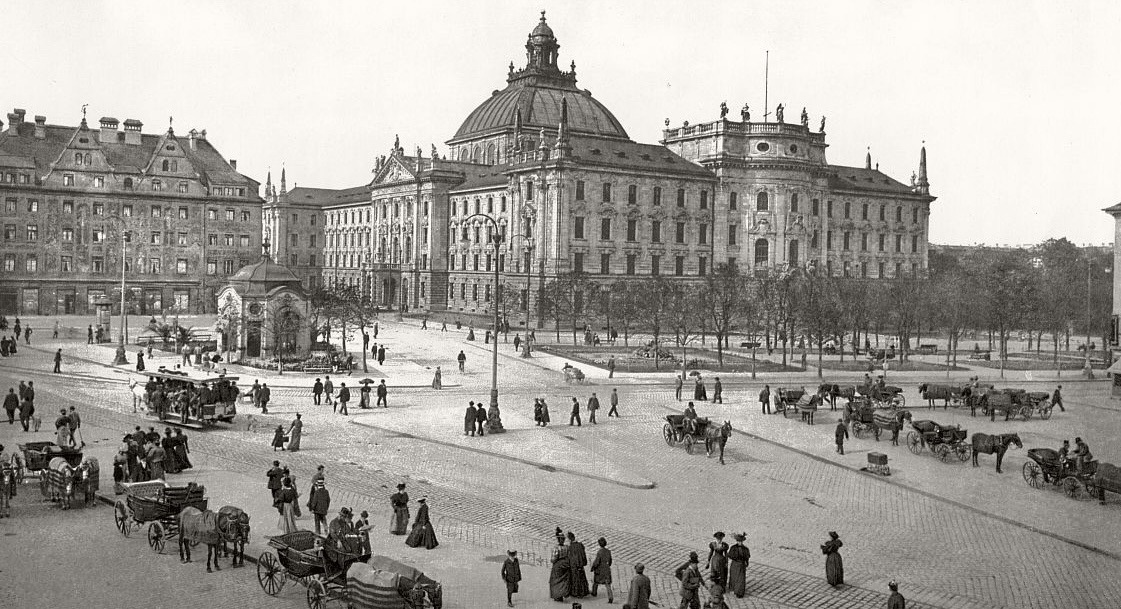
I started some fairly light reading about Munich, where we are going this October. I wasn’t at first feeling up to digging around for too many old travelogues… And at first it was refreshing indeed to land on some simple letters from 1903 after spending so much time with a missionary’s perspective in Kenya!
Well, I guess if you know me you’ll know that I ended up going down a rabbit hole and reading far more than I’d set out to… Most of the travelogues below only featured snippets of Munich / Stuttgart / Ulm / Esslingen (our planned itinerary), and I focused only on those portions rather than reading the whole of each work.
A chronological list below — everything is nonfiction unless specified otherwise:
- Visits and Sketches at Home and Abroad, 1835
- Journal of a Horticultural Tour through Germany, Belgium, and part of France, 1835
- Spas of Germany, 1836
- Vienna and the Austrians, 1838
- The Initials: A Story of Modern Life, 1850 (novel)
- The Neckar, Once a Week, Series 1, Volume VIII, 1863
- From the Oak to the Olive, 1868
- Europe Viewed Through American Spectacles, 1874
- An American Girl in Munich, 1903
- Sound of Munich, 2006 (novel)
- The One from the Other, 2006 (novel)
- Germany’s Other Modernity, 2014
An American Girl in Munich, 1903
These letters from composer Mabel W. Daniels are a breath of fresh air! Published in 1905, after her 2-year stint in Munich where she studied music, they represent the perspective of an 25-year-old heading from Boston and her starry-eyed and rather amusing observations of a foreign land. The places she mentions are all close to where we will be staying in Munich, and her viewpoints of Germans are also at times quite funny (and often remain relevant today). For example, she explains how rarely you’ll hear a joke from a young German woman, and goes on to say:
I must send you one of the comic papers. They considerately print the point of a joke in italics. One has at least the satisfaction of knowing when to laugh, a virtue not to be despised when one considers the subtleties of modern wit, so called.
Do they still do this!? I have to say, this type of thing would have really helped me in my communications with English people and their specific brand of (completely unapparent to me but obvious to them) humour over the years.
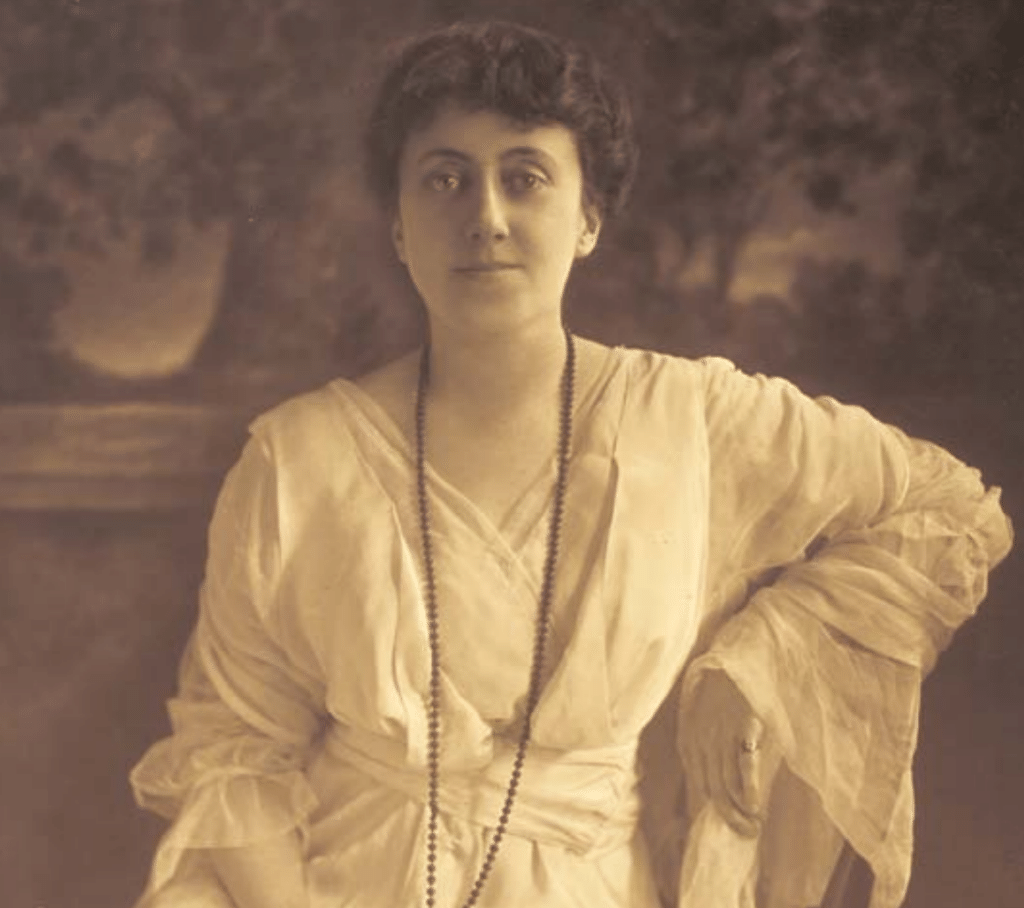
She went on to be quite a respected composer / music professor. From what I can see she remained thoroughly American, landing back in New England after this, and her foray into Germany seems to be one of the great adventures of her life.
And it’s fun to compare how the separate cultures have changed:
The blue-bloused Dienstmann behind the counter found my box for me and cut the string, for which I, of course, gave him a tip. (You know nothing is free in Germany. We have to pay even for our programs at the theatre or opera.)
Could it be that American tipping culture is really an unchanged relic of European ways!? This is indeed mentioned in a few of the other travelogues I read, dating back to the 1870s at least.
Sound of Munich by Suzanne Nelson (2006)
Same topic, 100 years later. This is a very nostalgic (to millennial me) young adult novel about an American girl studying abroad and leaving her country for the first time. The girl power, goal of finding one’s past and coming of age themes are all prevalent and so pure and reminiscent of the optimism of 20 years ago. It’s also written in a very particular time technologically — that gap when we had Internet, but still needed to head to the computer lounge to connect with the world, we had mobiles, but no smartphones to constantly tell us where to go or what to do.
In short, a fun easy novel but by no means well written or unique.
It is hard to find in print now but there is an audiobook available here.
Germany’s Other Modernity, Munich and the making of metropolis 1895-1930 by Leif Jerram, 2014
Nonfiction! This is an academic text describing the history of Munich’s modernisation between 1900-1930, and it reminds me of a good deal of what I read about regarding the history of Hamburg, which I wrote about previously on my Hamburg trip. There was a huge focus on reforming and making more effective the cities of the early 20th century and a good deal of these efforts happened in Munich.
Dry? Yes maybe. But it was a nice way to get a background for what was shaping the city in this period. And I actually found the chapter on kitchens really fascinating — did you know that as the state started to develop buildings for its citizens, they increasingly foisted expectations and ways of living on them by actually designing the spaces to an ideal? For example, in Frankfurt in the early 20th century they built closed-off kitchens (which apparently women actually hated) in an attempt to achieve efficiency: let the women have a distinct workspace like men have theirs. In Munich, they developed an open-plan kitchen, allowing women to embody their role as a distinct, indivisible body caring for the home.
And did you know that apparently the idea of having a cluttered, hard-to-clean home was actually a good thing for middle to lower class women in these days? Apparently the administrators didn’t realise this (making many assumptions about women), but if a woman of the household can keep everything clean and tidy despite it being hard to clean, that was a good thing, as she looked more impressive / respectable to her community.
OK, enough of the kitchen tangent.
From the Oak to the Olive, A Plain Record of a Pleasant Journey by Julia Ward Howe, 1868
Project Gutenberg is a place I often start with to find relevant travelogues — the key is to begin reading just one and to use that one to comb through for references to others. Despite the brevity of this writer’s Munich trip (only two nights), she references other works that give more detail.
In this one, Julia Ward Howe (who was an American author) describes what to this day is considered the Munich Glypothek’s best works, the Barberini faun, which was restored in the 17th century, as well as the torso of Ilioneus (and this is how I discovered Jameson’s travelogue, below, as she mentions her).
You can purchase the ebook here.
Visits and Sketches at Home and Abroad, 1835
Parts 1 and 2 of this travelogue include descriptions of Munich. Anna Brownell Jameson was an art historian and travel writer born in Dublin. Hence her descriptions of Munich are heavily focused on the art with which it abounds. She arrived when the Glyptothek and Pinakothek are brand new (or still being built); and she also peaks into the new palace during its construction. I’m not much of an art connoisseur – for me the interest in seeing the people she meets, and I often find myself googling names to find other references to people in the travelogues I read.
The interesting point here is her association with a variety of artists, musicians, architects in 1830s Munich; particularly Leo von Klenze, who, it turns out, would go on to design the Hermitage in St Petersburg. She spends more than a few days with him being taken around all of these new, for them modern, and very art-influenced galleries, palaces and museums. He is also mentioned extensively and with admiration in the other works I read, in which none of the other travellers had a chance to meet him.
There’s no suggestion of this whatsoever but when paired with the description of her unhappy marriage (she went years without seeing her husband), it’s easy to imagine a tryst unfolding… OK, yes, that’s me romanticising it a bit much, I know.
The first part is available here.
Journal of a Horticultural Tour through Germany, Belgium, and part of France, 1835
Next up is from the same era, written in 1835. The head gardener James Forbes of Woburn Abbey is sent on an expedition throughout Europe to see what contemporary estate gardens are like. It is amusing to see that whereas Jameson spends pages and pages minutely describing the galleries she goes to, Forbes does this in a sentence and of course focuses on the botany of it all. He describes Nymphenburg Palace, which I would like to visit, and also takes the same route we will be taking up from Munich to Ulm and Esslingen and Stuttgart.
Interestingly, he meets the Russian ambassador in Stuttgart, who I guessed is an ancestor of my friend from university!
Here is the Project Gutenberg version.
Views Afoot, or Europe seen with Knapsack and Staff by Bayard Taylor, 1845
Ten years later, this American set off on foot around Germany and had a very different experience compared to the well-to-do travellers in the travelogues above. His route goes from Munich to Ulm to Stuttgart, and he doesn’t say too much one way or the other about any where, other than to describe the previously mentioned galleries; and he focuses more on how he is traveling (frugally, and often by foot!).
His trip stands him in good stead and he goes on to build a solid career, becoming a well-respected poet. Of note is that he later travels with Mark Twain on the way to Europe (where he becomes a diplomat), and is noted to have an envious command of the German language, presumably picked up on these travels when he was only in his early 20s.
Vienna and the Austrians: With Some Account of a Journey Through Swabia, Bavaria, the Tyrol, and the Salzbourg, by Frances Trollope, 1838
There is a railroad mentioned in the previous travelogue, but here we are back 10 years earlier, again with only carriages and stagecoaches to get on with.
I’m pretty certain I’ve read some writings by her son, Anthony Trollope, who also traveled. Frances Trollope also has an interesting book about Americans and their manners which I’ve been meaning to read at some point.
In this one, Trollope is decidedly dissatisfied with Munich, after not being able to find a place to stay and also not being able to view the galleries (they are closed for the month). To quote:
And what shall I tell you about it all? That I admire Munich, its gaudy decorations, its ambitious architecture, and its smart new residence [the New Palace]? I cannot honestly do this; for neither the general aspect of the town, nor the peculiar style of the new palace, suit my taste. Some allowance I advise you to make for the ill-humour in which I write; nevertheless, I will tell you the truth…
Poor traveler! Her dismay is an experience I’m sure we’ve all had on our journeys. And quite amusing to read about.
Read about her travels here.
Europe Viewed Through American Spectacles by Charles Carroll Fulton, 1874
Here we are with more American perspectives of German culture. The editor of the Baltimore American, Charles Carroll Fulton, writes (like Mark Twain did) as a correspondent to Americans to detail his journey through Europe. The comparisons between Americans and Germans are amusing. He describes carefully each place he visits.
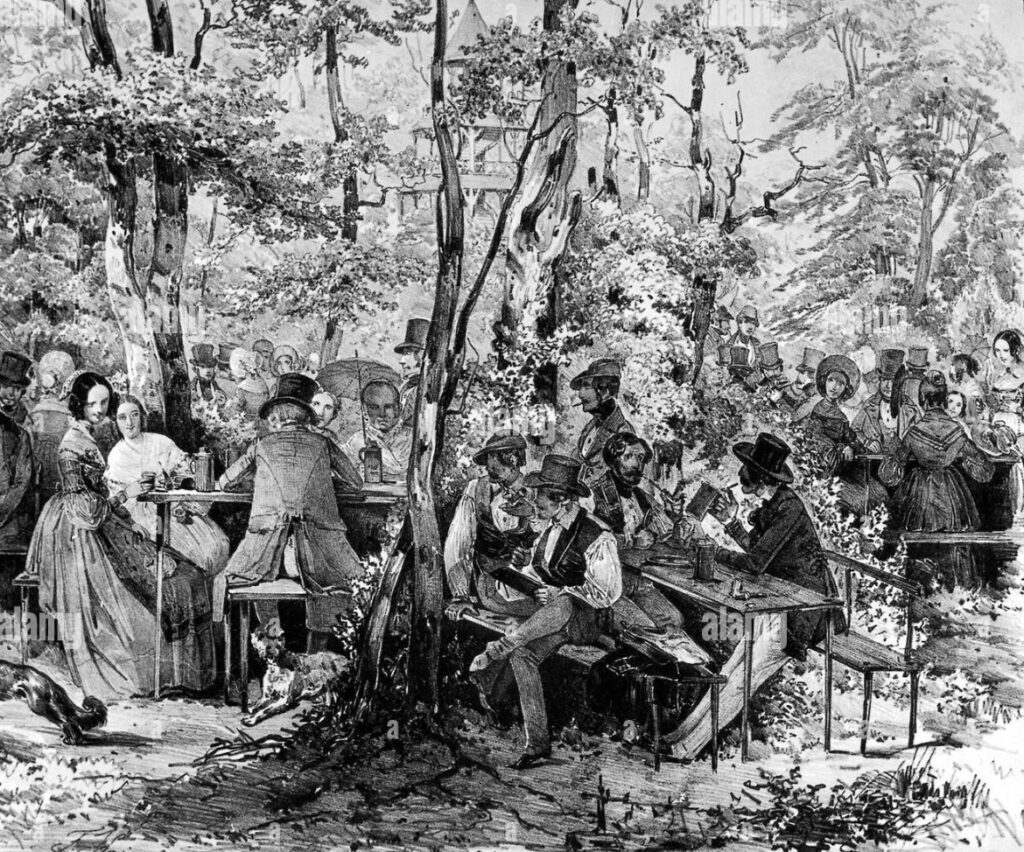
In order to learn more about the culture of beer in Munich, they visit the ‘royal brewery’ where huge mugs of beer are served. He points out:
The probability is that this young couple were reared on beer,—that it has been part of their daily nourishment from their cradles down to the present day. We frequently see whole families dining in the “restaurations,” and the beer-mug is handed around to the youngest of the children. Even nursing infants are accustomed to drink it, and will stretch out their little hands in entreaty before their tongues have been taught to lisp the word “beer.”
He clearly must have loved the beer culture, though, because most of his Bavaria recollections is about sitting in beer gardens! For the good of observing culture, of course.
You can find the PDF here.
Spas of Germany by A. B. Granville, 1836
Dr Granville gives a somewhat bland description of all of the spas in Europe (Germany)? If you’ve ever been to Baden-Baden, or Bath, for example, you’ll know how integral to the leisure / sick life spas were to the Victorians. Is there any evidence they actually had any effect? I love a good spa, to be sure, and even today, for example, the Japanese will expound on the healing qualities of certain of their onsen waters (with a very regimented, scientific way to categorise them). So perhaps there’s something to it?
Regardless, this piece is a bit of a bore and I read through his descriptions of 1830s Stuttgart and Munich relatively quickly.
Anyway, I’ve not read about Munich from the perspective of both botany and cholera, so that’s something. Read it here.
The Initials: A Story of Modern Life by Baroness Jemima Montgomery Tautphoeus, 1850
Finally a novel again! You can buy the ebook here and the paperback here.
I added this to my list because of its setting in / around Munich. It is written by an Irish novelist who understood German culture very well as she had married into the country. Only one chapter in, it was already an amusing romp compared to what I had been reading – with lots of discussion of travel in these days, and some funny interactions.
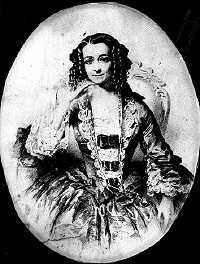
The characters are genuinely funny and engaging. It’s a forgotten novel from 175 years ago but it’s fascinating to see the little differences / observations she sprinkles in about England vs. Germany; and it was altogether a revitalising read!
The Neckar, Once a Week, Series 1, Volume VIII, by Gerard Manley Hopkins, 1863
A magazine article written about the Neckar river region which encompasses Esslingen, where we will be staying for two nights. Hopkins was a poet and a Jesuit priest. This would have been written when he was only 19.
The One from the Other by Philip Kerr, 2006
Also on my list is this work by Philip Kerr, a thriller writer whom I read before on a trip to Berlin last year. This one is set in Munich and we will see if I get to it. I’ve also got a lot of reading left to do before we head to Kenya the week after this trip!!
Purchase the paperback version here.
Want to find out more about me and where I’m heading to next? Take a look here. And please note that I earn commissions for some of the links on this post.