My trip was planned with a little less than two months to go, and I wasn’t really intending to get into travelogues about Hamburg. I started by casually reading up on the travelogues I’d read for Copenhagen which had various mentions of the city, often the first port of call for travellers coming by boat from England. Just doing that sparked my curiosity, though, and I ended up going a bit deeper than I’d intended with my reading!
I was also going to Lübeck, and didn’t expect to find any literature featuring the Hanseatic town. Most people I spoke to asked why I was even going there (you can see my reason and my plan for the trip here). But it turns out two Nobel prize winning authors are from there!
Unlike some other locations, Hamburg was not generally a destination in itself. It was the first stop at the beginning of a trip due to its busy harbour and maritime activities; usually this was to Scandinavia or farther east. As such, I found no travelogues that solely featured Hamburg. Instead, these writers included Hamburg and sometimes Lübeck as part of their journey, often only a few pages. I had fun piecing all these together.
I’ll try to list the various writers I read chronologically before expanding on each:
Travelogues about Hamburg
- 1795: Letters Written During a Short Residence in Sweden, Norway, and Denmark by Mary Wollstonecraft
- 1798: Satyrane’s Letters by Samuel Taylor Coleridge
- 1798: Continental Journals, 1798-1820 by Dorothy Wordsworth
- 1799: Journal Kept During a Visit to Germany in 1799, 1800 by Melesina Chenevix St. George Trench
- 1804: Travels from Hamburg, through Westphalia, Holland, and the Netherlands, to Paris by Thomas Holcroft
- 1857: Unprotected Females in Norway by Helen Lowe
- 1936: German Diaries 1936-1937 by Samuel Beckett
- 1991: Neither Here nor There: Travels in Europe by Bill Bryson
Analysis and novels about Hamburg
- Hamburg: A Cultural History by Matthew Jefferies
- Writing from Hamburg: The Encounter with Foreignness in the Writings of Mary Wollstonecraft and S.T. Coleridge by Kimberley Page-Jones
- “She Gave Me Eyes, She Gave Me Ears”: A Biographical Approach to Dorothy Worldworth’s Sense of Place by Tesi di Laurea
- Idyll, history, rationality: city images in “Real Journey to Germany in 1835” by Nikolay Gretsch (Russian)
- Little Herr Friedemann by Thomas Mann (Lübeck)
- Death in Venice by Thomas Mann (author from Lübeck)
- The World That Summer by Robert Muller (autobiographical novel)
- Ticket to Ride by Graham Sclater
- A Most Wanted Man by John le Carré
Eighteenth century travelogues about Hamburg
I stumbled upon 18th century feminist Mary Wollstonecraft’s travelogue last year and was struck by her descriptions of Hamburg. She wrote about her time transiting there in her Letters Written During a Short Residence in Sweden, Norway, and Denmark.
Interestingly, this academic article compares her stay which happened contemporarily to poet Samuel Taylor Coleridge’s own journey to Hamburg. It also lists plenty of other travelogues from the era (some of which I already read last year). The author makes the case that Wollstonecraft is focussed on distance, on being on her own, on exploring where she is going; but Coleridge, whilst analysing and taking in everything around him, always seems anchored back to his homeland.
Coleridge wrote about his visit across several different mediums — his journal, letters back home and then some published articles called Satyrane’s Letters in his Biographia Literaria. It is especially interesting to compare how he talks about a place when he considers the various audiences in mind: his wife; the general public; or himself (but who can know whether his journal would have truly been considered private?).
On top of that, Coleridge was traveling with poet William Wordsworth and Wordsworth’s sister, Dorothy Wordsworth, who also wrote about her trip in her diary. They even have several passages that show that they were clearly at the same place at the same time, as you’d expect when traveling together, but with slightly different perspectives of the same event. You can read an analysis of her general travel diaries in this article here, and this book is a publication of them entitled Continental Journals, 1798-1820. They traveled in 1798. Unlike Coleridge, she had terrible seasickness on her journey — something she never refers to directly, whereas Coleridge does, showing the difference in styles different authors have; Wordsworth kept a more formal tone in her diaries.

Shortly after, in 1799, Melesina Chevenix traveled to Germany on her own as a young widow. She was a well-to-do aristocrat with a privileged perspective into court life in the 18th century.
I really loved her journal! It is a real contrast of the high nobility travel lifestyle versus that of the more ordinary traveller during this era. She meets the wealthy and famous, such as Nelson (of the Napoleonic Wars) and various princes. It is interesting to note that she stays in a fairly luxurious abode with a baron whilst in Hamburg, is able to break curfew (i.e., leaving the city after seven o’clock at night, which was not allowed) and travels with many servants. In contrast to this, the other journals I read — by no means were these people poor — depicted filthy inns, swindling landlords and much discomfort traveling.
Melesina seems aware of her position; she says that she understands that she cannot get the most out of her travel experiences because she must associate with other nobility whilst traveling alone as a woman. She does not get much exposure to authenticity or ‘real’ people, and she knows it. I really enjoyed reading about her life in general and wish there as more info about her out there.
Set around this time period, there was also a novel, Water Music by T. C. Boyle, that had been mentioned as featuring Hamburg. But it was far too long and Hamburg didn’t seem to be a cornerstone of the book, so I didn’t read it. It features exploration in the late 1700s though which would be fun for another time.
Nineteenth century travelogues about Hamburg
Moving on in time. In 1804, Thomas Holcroft jumped on the trend of showing a bit of distaste for poor Hamburg in his own travelogue. He was swindled by an innkeeper here and that’s the extent of his analysis of the place. His writing, in general, is rather stuffy – probably what most people imagine when I tell them my passion is very old travelogues…
Unprotected Females in Norway: Or, the Pleasantest Way of Travelling There, Passing Through Denmark and Sweden, with Scandinavian Sketches (that’s a mouthful) features a journey from 1857. They write a few lines about Hamburg to describe it rather quaintly. This differs from other travellers from this (and earlier) time periods who seemed only to dislike Hamburg!
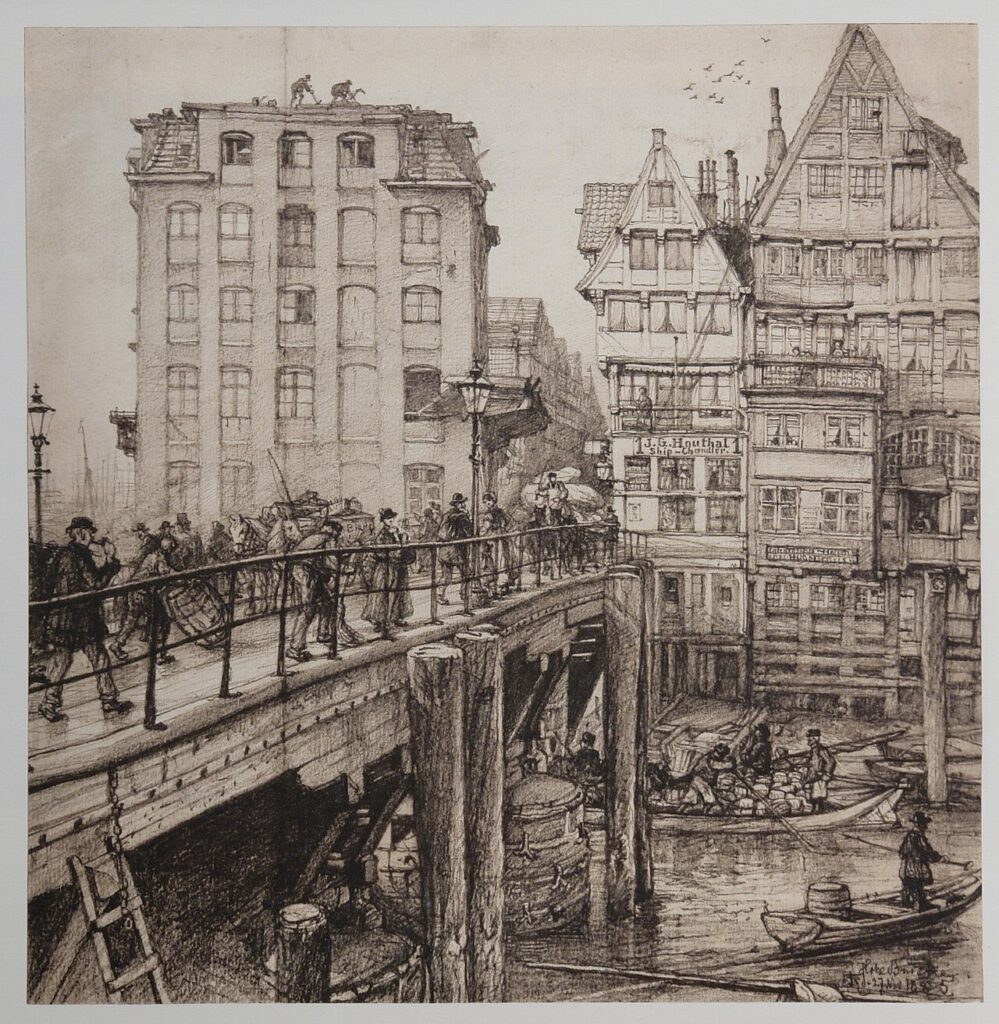
I happened on an analysis of a Russian travelogue and discovered a whole new category of travel I need to one day look into. Russian travellers were of course relatively common on European travels and many of my other travel writers mention encountering them. This article in particular compares Lübeck and Hamburg, showing how Hamburg symbolises the more modern city and Lübeck the medieval idyll. It mirrors the journey I’m about to go on! In 2011, my Russian was probably good enough to read this article, but this time I didn’t get much past the abstract, which is already translated anyway. I guess I’ll tackle Dutch travelogues first before trying for Russian ones… (luckily I have some of those in my pocket!).
Books featuring Nazi Germany Hamburg
Irish author Samuel Beckett journeyed through Germany in 1936-1937 and wrote a detailed journal during his visit. He spent nearly two months in Hamburg. I did not have a chance to read through his diaries, but I found this summary of Samuel Beckett’s trip through Germany. You can also get this book here about him.
Another book about the era is an autobiographical story, The World That Summer by Robert Muller, depicting the tense life of a boy who must hide his Jewish heritage whilst participating in the Hitler Youth in 1936. I read this because of the tensions I’ve been personally feeling lately around Europe. I wanted to compare the feeling of those scary days to now. The answer of course is that Nazi Germany seems much more terrifying. There was also a film made about the book in German in 1980, Die Welt in jenem Sommer. Muller’s story is enthralling, and I wish I could find more about it online — maybe I need to dig around in German. He managed to leave on the kindertransport to England before the war started; but what happened to his family?
A lot of other novels I found about the region seem to focus on the World War II and Cold War era, understandably. I wasn’t that interested in reading about this time period, though, so I chose some other books.
Books featuring contemporary Hamburg
I chose to read a history of Hamburg, entitled Hamburg: A Cultural History. This book gave me so many ideas for places I want to see and other authors to read. I enjoyed it. I think reading a proper ‘biography’ of a city itself is a great way to get to know a place before you visit and to build that anticipation. Written in 2011, it was curious to reflect that surely there is yet more history to add to this book now, fifteen years later!
It is best, I think, to read this after you’ve already read a good deal of travel pieces about the region – so that it feels like you’re finally able to crack the code, so to speak, and really understand the background to everything you’ve been exploring. I’m not sure I would recommend reading a city history first. While it certainly gives you a solid foundation upon which to understand any travelogues you read next, it takes away the excitement of discovery that you sometimes are able to grasp along with the writer when reading their travel diaries.
I would definitely read a history some time prior to the trip though, and save a fun book for when you are actually en route. As for that fun book, I chose A Most Wanted Man by John le Carré, a thriller by a British author. This was also made into a film in 2014.
There is also this travelogue by Bill Bryson, a humorous take on traveling in Europe; I’ve not yet gotten to it. He mentions Hamburg. And this book by Graham Sclater, written in 2006, is a bit more of a dark portrayal of the music scene in Hamburg in the mid-20th century (I opted not to read this one as I was running out of time). Did you know that Hamburg had a massive impact on the Beatles, before they were really famous?
Novels related to Hamburg: Nobel laureates from Lübeck
I tend to seek out books originally written in languages that I know when I read about a place. I like having that direct access to an author’s mind. On the other hand, it is true that the only way to get access to another culture’s perspective without knowing their language is to read something in translation. With that in mind I delved into the works of Thomas Mann for this trip.
Lübeck boasts not one but three Nobel laureates and two of those are authors: Thomas Mann and Günter Grass.
The Günter Grass House museum looks lovely and even boasts a kids’ section. I didn’t get time to read to any books by him this time around.
Thomas Mann wrote a good deal about where he was from, with books featuring both Hamburg and Lübeck. I read Little Herr Friedemann which is a short story set in Lübeck. This does indeed give me a taste of Mann’s works: inward-facing, desperation, being an outsider. Then I opted for a quick read (with only a few days to go to my trip!), the well-known tale Death in Venice which was also made into a film. This one was pretty grim! I appreciated how he depicts Venice as precisely what it is today — half fairytale city, half tourist trap.
Phew, that was a lot of reading.
If you’re ready to relax and watch a fun film, try a rewatch of the James Bond Tomorrow Never Dies which just so happens to have some great action scenes set in… you guessed it: Hamburg.
Want to find out more about me and where I’m heading to next? Take a look here. Also, if you buy books linked to my blog, we may earn a commission from Bookshop.org, whose fees support independent bookshops.